Protect your workers. Improve workplace safety. Equip your construction site with confidence.
Construction safety equipment is essential for protecting workers, contractors, engineers, technicians, and site supervisors from workplace hazards. Whether you are managing a building project, road construction site, manufacturing plant, warehouse, mining operation, or oil and gas facility, choosing the right Personal Protective Equipment (PPE) helps reduce workplace risks and supports compliance with occupational health and safety requirements.
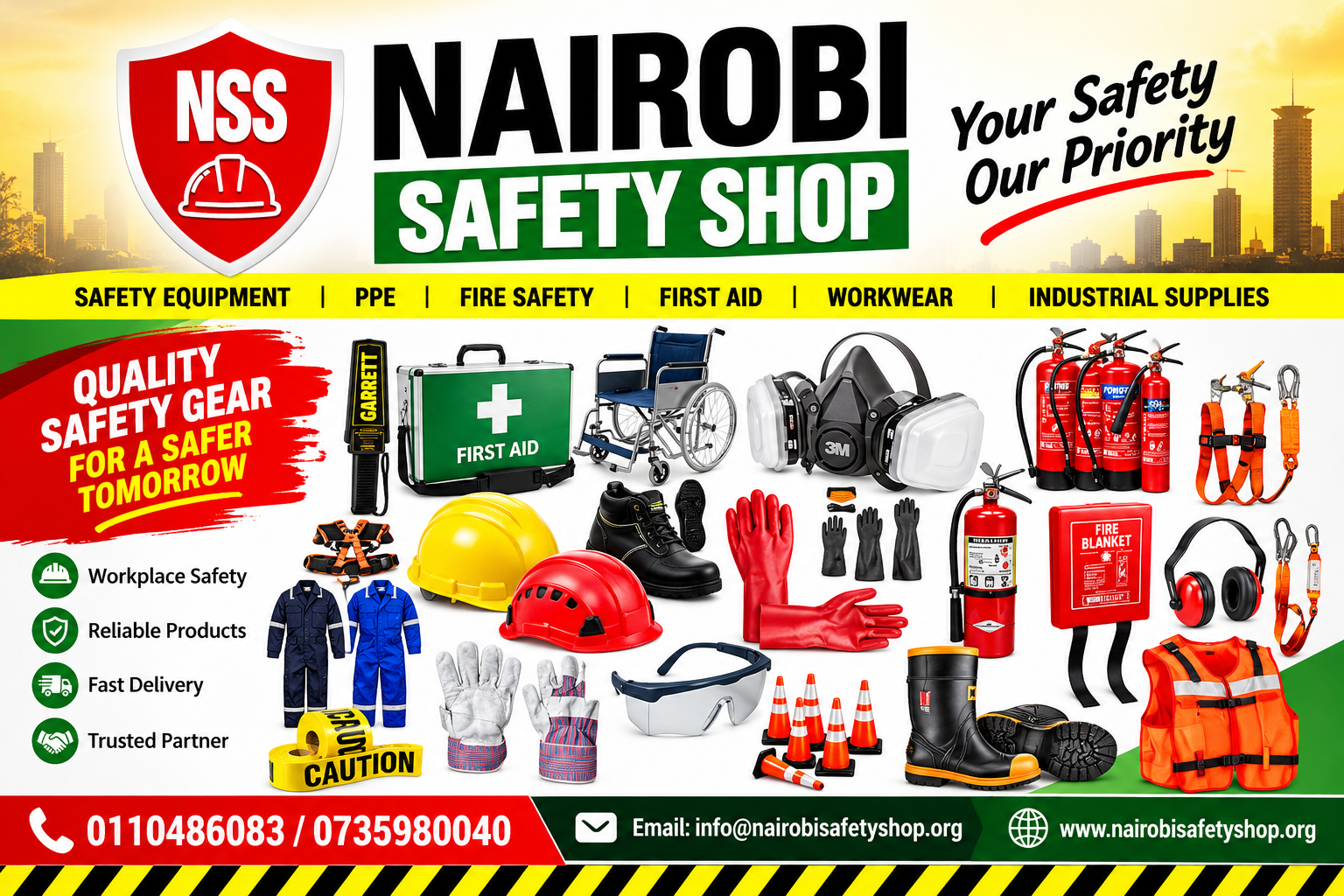
Nairobi Safety Shop supplies construction safety equipment, industrial PPE, fall protection equipment, protective clothing, safety footwear, and workplace safety products for businesses and professionals across Kenya.
From safety helmets and reflective jackets to full-body safety harnesses, lifelines, protective gloves, and industrial safety boots, we help businesses source essential equipment for safer working environments.
If you are searching for a reliable construction safety equipment supplier in Kenya, Nairobi Safety Shop is your destination for workplace protection solutions.
Your Trusted Construction Safety Equipment Supplier in Kenya
Construction sites expose workers to several hazards, including falling objects, working at height, sharp materials, dust, excessive noise, slippery surfaces, moving machinery, and electrical risks. The right safety equipment helps workers perform their duties while reducing exposure to these hazards.
At Nairobi Safety Shop, we understand the importance of equipping construction teams with suitable PPE for their working environments.
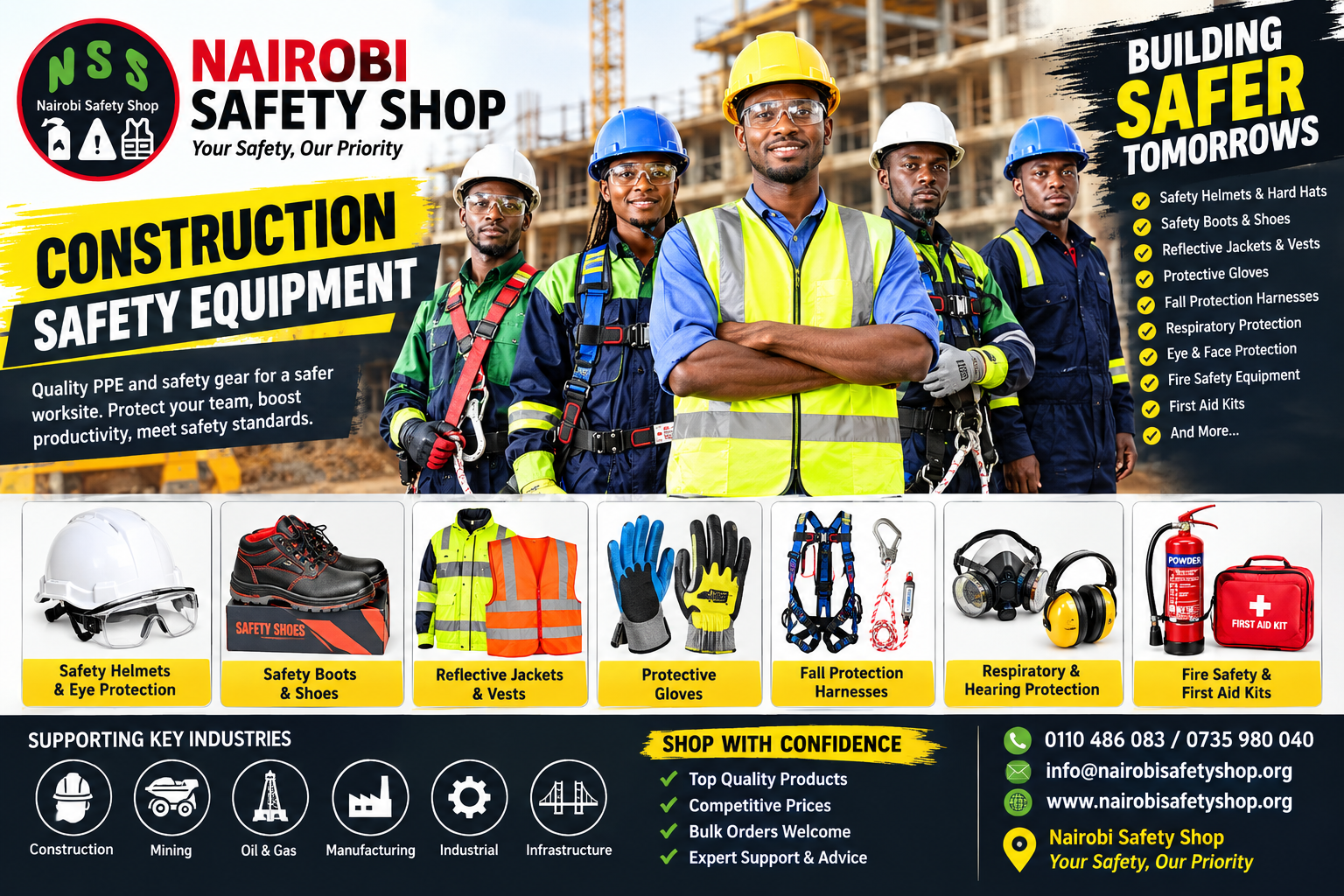
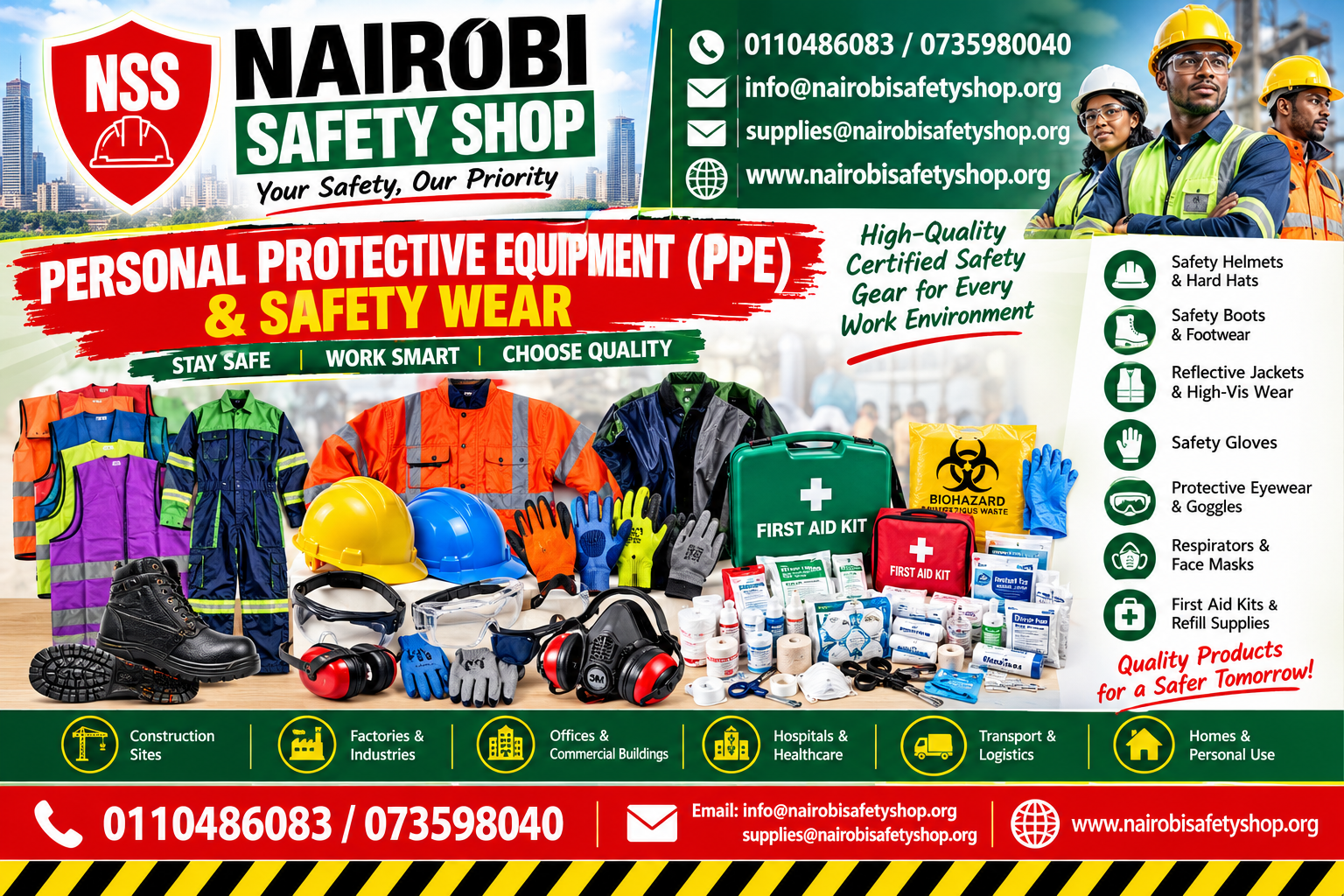
Our construction and industrial safety equipment range includes:
- Safety helmets and hard hats
- Reflective safety jackets and high-visibility vests
- Industrial coveralls and protective workwear
- Safety boots and protective shoes
- Full-body safety harnesses
- Safety lanyards, lifelines, and fall arrest equipment
- Protective gloves for construction and industrial applications
- Safety goggles and protective eyewear
- Earplugs and hearing protection earmuffs
- Dust masks and suitable respiratory protection
- Safety signs, caution boards, and hazard warning signs
- Fire extinguishers and first aid supplies
Whether you need PPE for an individual worker or safety equipment for an entire construction workforce, choose products suited to the hazards, work activities, and safety requirements of your site.
Essential Construction Safety Equipment for Every Job Site
1. Safety Helmets and Hard Hats
Safety helmets are among the most important items of construction PPE. They help protect workers from specified head injuries caused by falling objects, impacts, and other site hazards.
Construction helmets are commonly used by:
- Building contractors and construction workers
- Civil engineers and site supervisors
- Road construction crews
- Electricians and maintenance technicians
- Warehouse and industrial personnel
- Mining and oil and gas workers
When selecting a safety helmet, consider the type of work, impact protection requirements, fit, compatibility with hearing protection, and any electrical hazards. Replace damaged helmets and follow the manufacturer’s inspection and replacement guidance.
2. Reflective Safety Jackets and High-Visibility Vests
High-visibility clothing helps workers remain visible in environments with vehicle movement, heavy machinery, low lighting, or busy construction activities.
Reflective safety jackets and vests are suitable for road construction, traffic management, logistics, warehouses, engineering projects, and outdoor work.
Nairobi Safety Shop supplies high-visibility PPE options for teams that need improved worker visibility and identification on site.
Choose visibility clothing appropriate to the lighting, traffic conditions, environmental risks, and applicable safety requirements.
3. Full-Body Safety Harnesses and Fall Protection Equipment
Working at height is one of the major hazards in construction, industrial maintenance, roofing, scaffolding, and steel erection. A suitable fall protection system can help prevent falls or limit the consequences of a fall when correctly selected and used.
Fall protection equipment may include:
- Full-body safety harnesses
- Shock-absorbing lanyards
- Double-leg safety lanyards
- Self-retracting lifelines
- Vertical and horizontal lifeline systems
- Approved anchorage connectors
- Connectors and compatible fall arrest components
Harnesses and lanyards must be compatible with the complete fall protection system and suitable for the intended application. Workers require proper training, equipment inspection, suitable anchorage, and a rescue plan before working at height.
Important: A safety harness alone does not make work at height safe. The entire fall protection system must be properly planned and used.
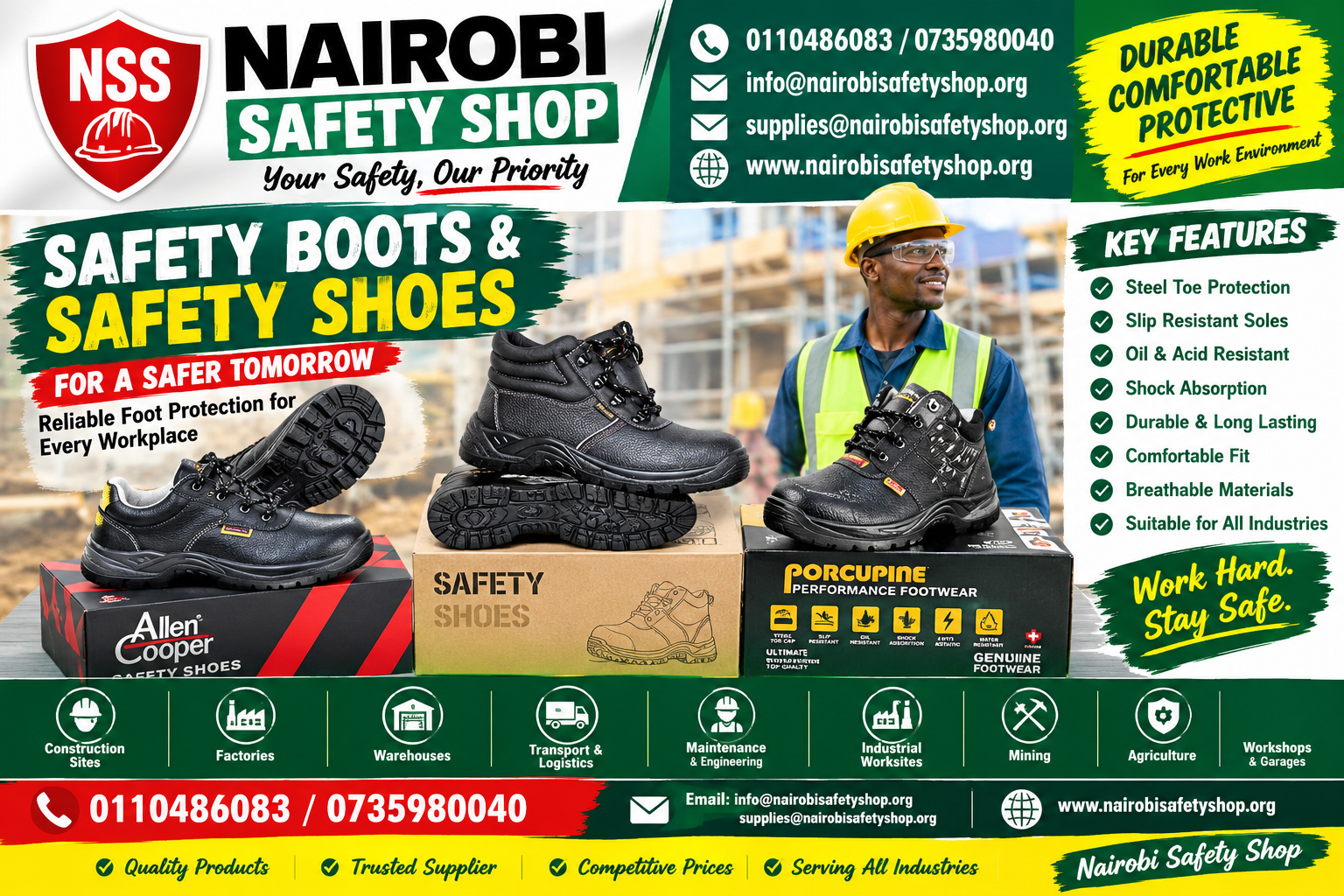
4. Industrial Safety Boots and Protective Footwear
Construction workers face risks from falling objects, sharp debris, uneven surfaces, wet floors, and heavy equipment. The correct safety footwear helps protect feet against identified workplace hazards.
Depending on the application, safety footwear may offer:
- Protective toe caps
- Penetration-resistant midsoles
- Slip-resistant outsoles
- Water-resistant or waterproof construction
- Resistance to certain oils and other substances
- Electrical hazard protection where specifically rated
Safety boots are commonly required on construction sites, in factories, mining operations, oil and gas facilities, and engineering workshops.
Choose safety boots according to the actual site hazards rather than appearance alone. Check the footwear’s protective ratings and suitability for the working environment.
5. Industrial Coveralls and Protective Workwear
Protective coveralls help shield workers’ clothing and skin from dirt, abrasion, splashes, and other workplace exposures, depending on the garment design.
Industrial workwear is widely used in construction, mechanical maintenance, fabrication, manufacturing, oil and gas operations, and general industrial work.
Options include:
- Standard industrial coveralls
- Reflective workwear
- Two-tone workwear
- Protective overalls
- Flame-resistant garments for suitable applications
- Specialist chemical-protective clothing where required
Not all coveralls provide the same protection. For welding, heat exposure, chemical handling, or flash-fire risks, select garments specifically designed and rated for those hazards.
6. Construction Gloves and Industrial Hand Protection
Hands are exposed to cuts, abrasions, sharp materials, heat, vibration, and chemicals during many construction and industrial tasks.
Different applications require different protective gloves, including:
- General-purpose work gloves
- Cut-resistant gloves
- Heavy-duty handling gloves
- Chemical-resistant gloves
- Heat-resistant gloves
- Specialist electrical protection gloves
Selecting the correct gloves requires understanding the material being handled, the type of hazard, the required grip, and the need for dexterity. Chemical and electrical work requires gloves specifically rated for the relevant exposure.
7. Safety Goggles and Protective Eyewear
Eye protection is essential when workers are exposed to dust, flying particles, grinding debris, splashes, or other eye hazards.
Construction and industrial eye protection may include safety spectacles, impact-resistant goggles, face shields, and specialist welding eye protection.
For grinding, cutting, welding, chemical handling, and dusty environments, choose the appropriate protective equipment for the specific task. Face shields may need to be used together with safety goggles or spectacles rather than alone.
8. Respiratory Protection and Dust Masks
Construction, mining, manufacturing, and industrial activities can generate dust, fumes, vapours, and other airborne contaminants.
Respiratory protection must be selected according to the substance, its concentration, exposure conditions, and the limitations of the respirator. A basic dust mask is not suitable for every airborne hazard.
Employers should prioritise effective engineering controls, ventilation, and dust suppression before relying on respiratory PPE. Where respirators are required, workers need appropriate selection, fit testing where applicable, training, maintenance, and replacement filters.
9. Hearing Protection Equipment
Workers operating power tools, compressors, heavy machinery, drilling equipment, and industrial production systems may face harmful noise exposure.
Hearing protection products include:
- Disposable earplugs
- Reusable earplugs
- Protective earmuffs
- Compatible hearing protection for use with safety helmets
Employers should assess workplace noise levels and select hearing protection that provides suitable attenuation without interfering with communication or other essential safety equipment.
10. Safety Signs, Fire Safety Equipment and First Aid Supplies
A safer construction site requires more than personal protective equipment. Effective hazard communication, emergency preparedness, and fire protection are also important.
Common workplace safety products include:
- Caution and warning signs
- Mandatory PPE signs
- Wet-floor and restricted-area signs
- Fire extinguishers suitable for identified fire risks
- First aid kits and workplace medical supplies
- Emergency response equipment
Safety signs should be positioned where workers and visitors can easily see them. Fire extinguishers must be selected for the relevant fire classes, maintained correctly, and supported by suitable emergency procedures.
Construction PPE for Different Industries in Kenya
Nairobi Safety Shop serves a range of industries where workplace protection is a priority.
Building and Civil Construction
Construction contractors may require helmets, reflective jackets, safety boots, gloves, eye protection, dust protection, and fall arrest systems for elevated work.
Road Construction and Infrastructure Projects
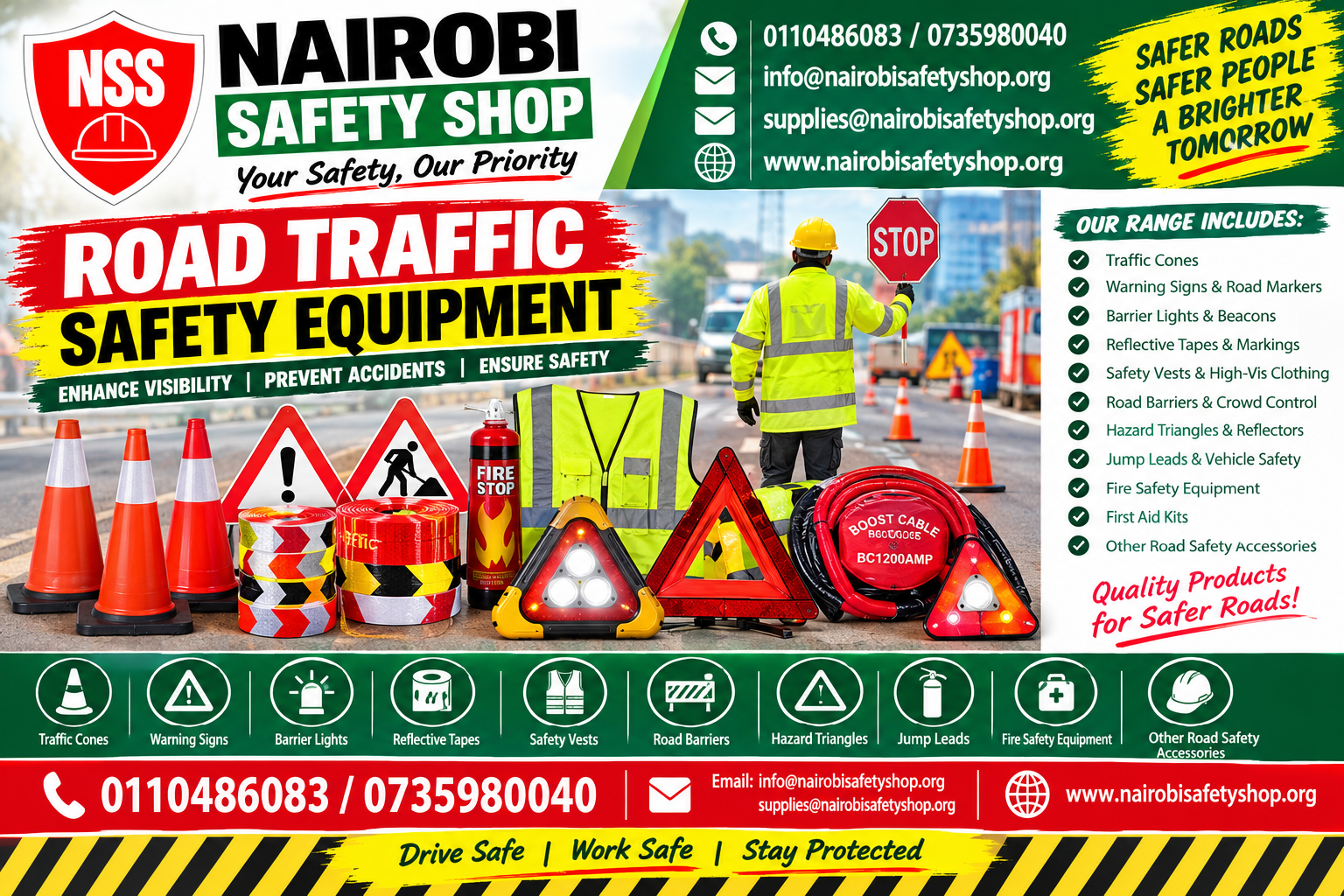
Roadwork teams may need high-visibility clothing, protective footwear, helmets, traffic safety equipment, warning signs, and other task-specific PPE.
Mining and Quarrying
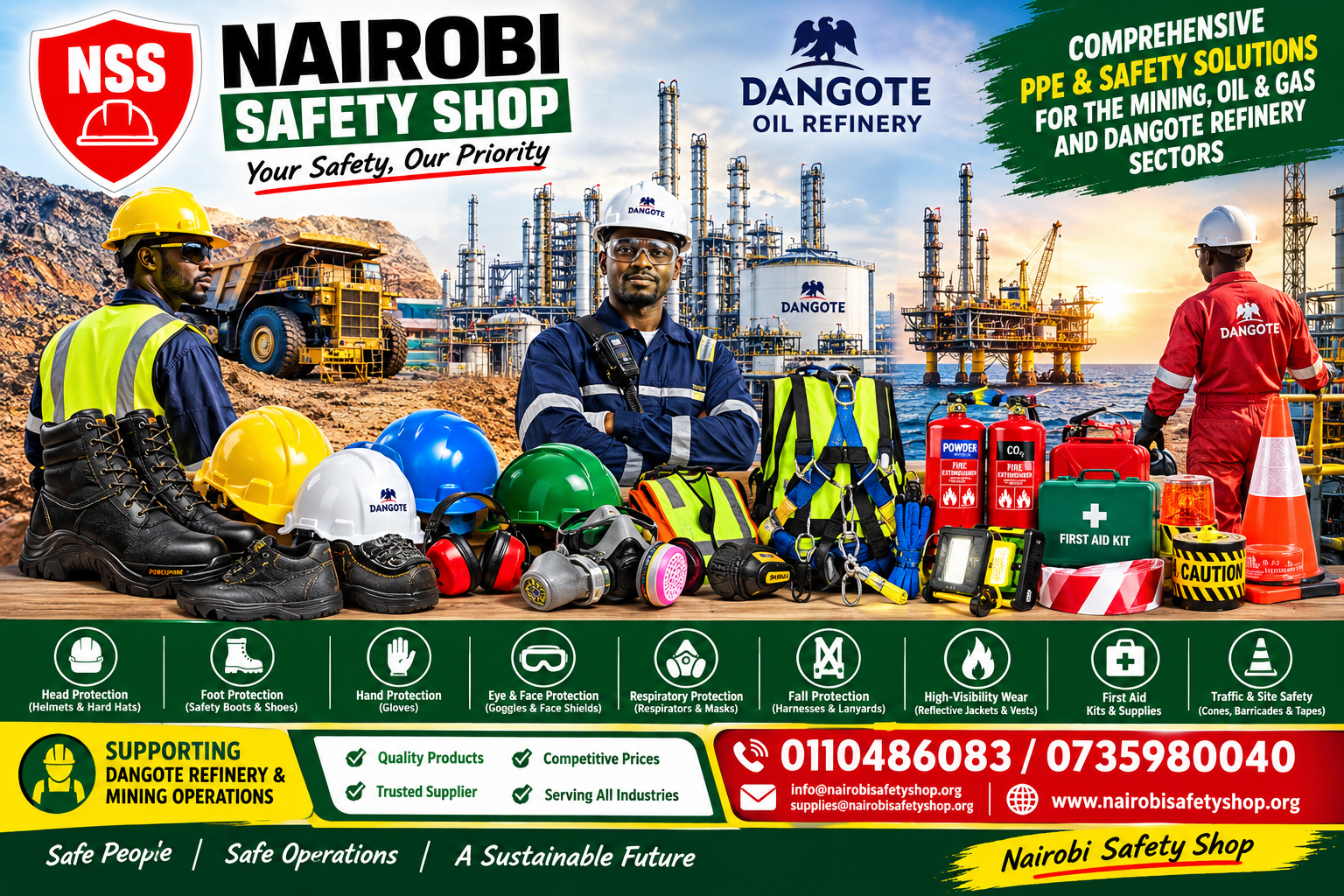
Mining and quarrying operations can require impact protection, protective footwear, hearing protection, suitable respiratory equipment, high-visibility clothing, and specialised PPE based on site risk assessments.
Oil and Gas and Refinery Operations
Oil and gas facilities and refineries require carefully selected PPE for mechanical work, maintenance, heat exposure, chemical handling, electrical hazards, and other identified risks.
Depending on the task, equipment may include flame-resistant workwear, suitable gloves, protective footwear, helmets, eye protection, respiratory equipment, and approved fall protection systems.
PPE intended for these environments must meet the applicable site specifications. Standard industrial clothing or general-purpose equipment should not be assumed suitable for hazardous-area, chemical, or fire-related risks.
Manufacturing and Warehousing
Factories, distribution centres, and warehouses commonly use safety shoes, reflective vests, gloves, eye protection, hearing protection, and helmets where required by the work environment.
How to Choose the Right Construction Safety Equipment
Purchasing PPE solely on price can leave workers inadequately protected. Businesses should assess both the hazard and the performance of the equipment before placing an order.
Consider the following factors:
1. Identify workplace hazards. Conduct a risk assessment to establish the risks associated with each job.
2. Select task-specific PPE. Choose equipment designed for the relevant hazards, such as impact-resistant helmets, cut-resistant gloves, or approved fall arrest equipment.
3. Check applicable standards. Review product markings, technical documentation, certification, and the relevant Kenyan and international requirements.
4. Prioritise fit and comfort. Equipment must fit correctly and remain compatible with other PPE.
5. Inspect before use. Check equipment for damage, deterioration, missing components, and expired service life where applicable.
6. Train workers. Explain how to wear, adjust, inspect, maintain, and replace each item.
7. Plan bulk procurement. Confirm sizes, quantities, product specifications, delivery arrangements, and replacement requirements before ordering for a large workforce.
Why Choose Nairobi Safety Shop for Construction Safety Equipment?
Finding the right safety equipment supplier helps businesses manage procurement while keeping workplace protection a priority.
Nairobi Safety Shop offers a range of safety and industrial equipment for construction professionals, contractors, companies, and organisations seeking suitable PPE supplies.
Reasons to contact us include:
- A range of construction and industrial PPE
- Safety footwear and protective workwear options
- Fall protection equipment for suitable applications
- Safety products for construction, manufacturing, mining, and industrial operations
- Options for individual purchases and workforce procurement
- Assistance with identifying equipment suited to your stated requirements
For larger projects, provide your bill of quantities, PPE specification, required sizes, quantities, and delivery location so that your order can be assessed accurately.
Product availability, technical specifications, and delivery arrangements should be confirmed when requesting a quotation.
Buy Construction Safety Equipment in Kenya
Are you looking for construction safety equipment in Nairobi or anywhere in Kenya? Nairobi Safety Shop can help you identify suitable PPE and industrial safety products for your project.
Whether you are equipping a small construction crew, a large building project, a roadworks team, a factory, or an industrial maintenance department, start by identifying your required equipment and the hazards your workers face.
Contact Nairobi Safety Shop to enquire about:
- Construction safety equipment
- Safety helmets and reflective jackets
- Industrial safety boots and safety shoes
- Full-body safety harnesses and fall protection systems
- Industrial coveralls and protective gloves
- Safety goggles and respiratory protection
- Workplace safety signs and emergency supplies
- Bulk PPE procurement for contractors and companies
Nairobi Safety Shop
Website: https://www.nairobisafetyshop.org/
Email: supplies@nairobisafetyshop.org
info@nairobisafetyshop.org
Phone / Whatsapp : +254 735 980 040 / 0110486083
Contact our team with your requirements to enquire about suitable equipment, pricing, availability, and delivery.
Frequently Asked Questions About Construction Safety Equipment
What is construction safety equipment?
Construction safety equipment includes PPE and other workplace protection products used to reduce exposure to hazards on construction sites. Examples include safety helmets, reflective jackets, safety boots, gloves, goggles, harnesses, and warning signs.
Where can I buy construction safety equipment in Kenya?
You can contact Nairobi Safety Shop through its website, email, or telephone to enquire about construction PPE, industrial safety equipment, product availability, and quotations.
What PPE is required on a construction site?
Requirements depend on the activities and hazards present. Common items include safety helmets, protective footwear, high-visibility clothing, gloves, and eye protection. Hearing, respiratory, and fall protection equipment may also be necessary for particular tasks.
What equipment is required for working at height?
Depending on the work, a fall protection system may include a full-body harness, compatible lanyard or lifeline, suitable anchorage connectors, and other approved components. Safe access, training, inspection, and rescue arrangements are also essential.
What safety equipment is used in mining and oil and gas?
Equipment depends on the site risk assessment and the work being performed. Common categories include helmets, protective footwear, coveralls, gloves, eye and hearing protection, respiratory protection, and specialist fall protection or flame-resistant equipment where required.
Can companies order construction PPE in bulk?
Businesses can contact Nairobi Safety Shop to discuss their required product specifications, quantities, sizes, and delivery arrangements for workforce procurement.
How often should safety equipment be replaced?
Replacement depends on the type of equipment, its condition, the manufacturer’s instructions, applicable standards, and exposure to damage. Damaged or defective equipment should be removed from service immediately. Fall protection equipment requires particular attention to inspection and service-life requirements.
Conclusion: Protect Your Workforce with the Right Safety Equipment
Construction safety equipment is a vital part of protecting workers, managing site hazards, and supporting safer project operations. From safety helmets and reflective jackets to industrial footwear, protective gloves, respiratory equipment, and fall protection systems, every item should be selected for its intended use.
For construction safety equipment in Kenya, Nairobi Safety Shop provides a point of contact for businesses seeking PPE and industrial safety supplies.
Make workplace safety a priority. Contact Nairobi Safety Shop today to enquire about construction PPE, industrial safety equipment, and bulk procurement for your next project.