Ebola disease is a severe infectious disease that requires strong surveillance, rapid detection, infection prevention and control, appropriate personal protective equipment, trained healthcare workers, laboratory capacity, safe waste management and coordinated emergency response.
For hospitals, clinics, laboratories, ambulance services, healthcare workers, cleaning teams, waste handlers, emergency responders, humanitarian organizations and other institutions, Ebola preparedness should begin before an emergency occurs.
Kenya has continued strengthening its preparedness because of its regional connectivity and extensive cross-border movement. In July 2026, Kenya’s Ministry of Health established a National Ebola Virus Disease Preparedness and Response Taskforce to strengthen surveillance, laboratory capacity, infection prevention and control, case management, emergency coordination and cross-border collaboration.
As of 7 October 2026, the Ministry of Health stated that Kenya does not have an Ebola outbreak, while reporting one imported confirmed case and ongoing preparedness and contact-tracing measures.
This guide explains Ebola preparedness in Kenya, the role of PPE, infection prevention and control, healthcare-facility readiness, emergency supplies and how organizations can develop a comprehensive preparedness program.
What Is Ebola Disease?
Ebola disease is a severe illness caused by viruses in the Orthoebolavirus genus.
According to the World Health Organization, Ebola disease can be severe and potentially fatal, although early intensive supportive care improves survival. WHO also explains that outbreak control relies on a combination of interventions, including infection prevention and control, surveillance, contact tracing, laboratory services, supportive care, safe and dignified burials and community engagement.
Ebola should therefore never be viewed simply as a PPE problem.
A strong Ebola preparedness program involves:
Surveillance + Early Detection + Isolation + IPC + PPE + Laboratory Capacity + Contact Tracing + Safe Waste Management + Training + Communication + Emergency Coordination
Is There an Ebola Outbreak in Kenya?
Current status matters.
As of 7 October 2026, Kenya’s Ministry of Health states that Kenya does not have an Ebola outbreak. The Ministry reported an imported confirmed case associated with travel from the Democratic Republic of Congo and said that Kenya is strengthening surveillance, screening, laboratory testing, contact tracing and response capacity.
This distinction is important for organizations publishing or communicating about Ebola.
The appropriate message is:
Kenya is strengthening Ebola preparedness and response capacity.
rather than:
Kenya is experiencing an Ebola outbreak.
Organizations should rely on the Kenya Ministry of Health, WHO and other competent public-health authorities for current outbreak information.
Why Ebola Preparedness Matters in Kenya
Kenya occupies an important regional position with extensive:
- International travel
- Cross-border movement
- Trade
- Tourism
- Healthcare connections
- Humanitarian operations
- Transport links
Kenya’s Ministry of Health has specifically cited the country’s strategic location, cross-border movement and regional connectivity as reasons for sustained Ebola preparedness.
Preparedness is therefore relevant not only to hospitals but also to:
- Airports
- Border points
- Ports
- Hospitals
- Clinics
- Laboratories
- Ambulance services
- Hotels
- Universities
- Schools
- Prisons
- Funeral-service providers
- Waste-management teams
- Cleaning contractors
- Security personnel
- Humanitarian organizations
- Emergency-response organizations
How Does Ebola Spread?
Ebola can spread through direct contact with the blood or body fluids of an infected person, including contact with contaminated objects or surfaces.
WHO states that transmission can occur through contact with body fluids such as blood, feces and vomit, particularly when the virus enters the body through broken skin or mucous membranes. Healthcare workers can face increased risk when infection-control precautions are not strictly followed.
This is why Ebola preparedness must focus heavily on:
Contact precautions
Hand hygiene
PPE
Environmental cleaning
Waste management
Safe handling of contaminated materials
Safe and dignified burial procedures
Staff training
Ebola Symptoms and Recognition
WHO reports that Ebola symptoms can include:
- Fever
- Fatigue
- Weakness
- Muscle pain
- Headache
- Sore throat
- Vomiting
- Diarrhea
- Abdominal pain
- Rash
- Impaired kidney or liver function
- In some cases, internal or external bleeding
The incubation period is generally 2–21 days. Ebola can be difficult to distinguish clinically from other diseases such as malaria, typhoid and meningitis, which is why appropriate medical assessment and testing are important.
Important
This article is an preparedness and safety resource, not a diagnostic guide.
Anyone with a concerning illness or possible exposure should follow the instructions of qualified healthcare professionals and public-health authorities.
🦺 Ebola PPE: Why Personal Protective Equipment Matters
Personal protective equipment is an important part of Ebola infection prevention and control.
WHO identifies PPE used in Ebola response as potentially including:
- Gloves
- Masks/respiratory protection as appropriate
- Gowns or coveralls
- Face protection
- Goggles
- Head protection
- Protective boots
The exact PPE ensemble depends on the activity, exposure risk, healthcare setting and applicable guidance.
WHO also emphasizes that PPE is important not only in Ebola treatment centres but in activities such as:
- Cleaning
- Waste management
- Safe burials
- Community care
- Other outbreak-response activities
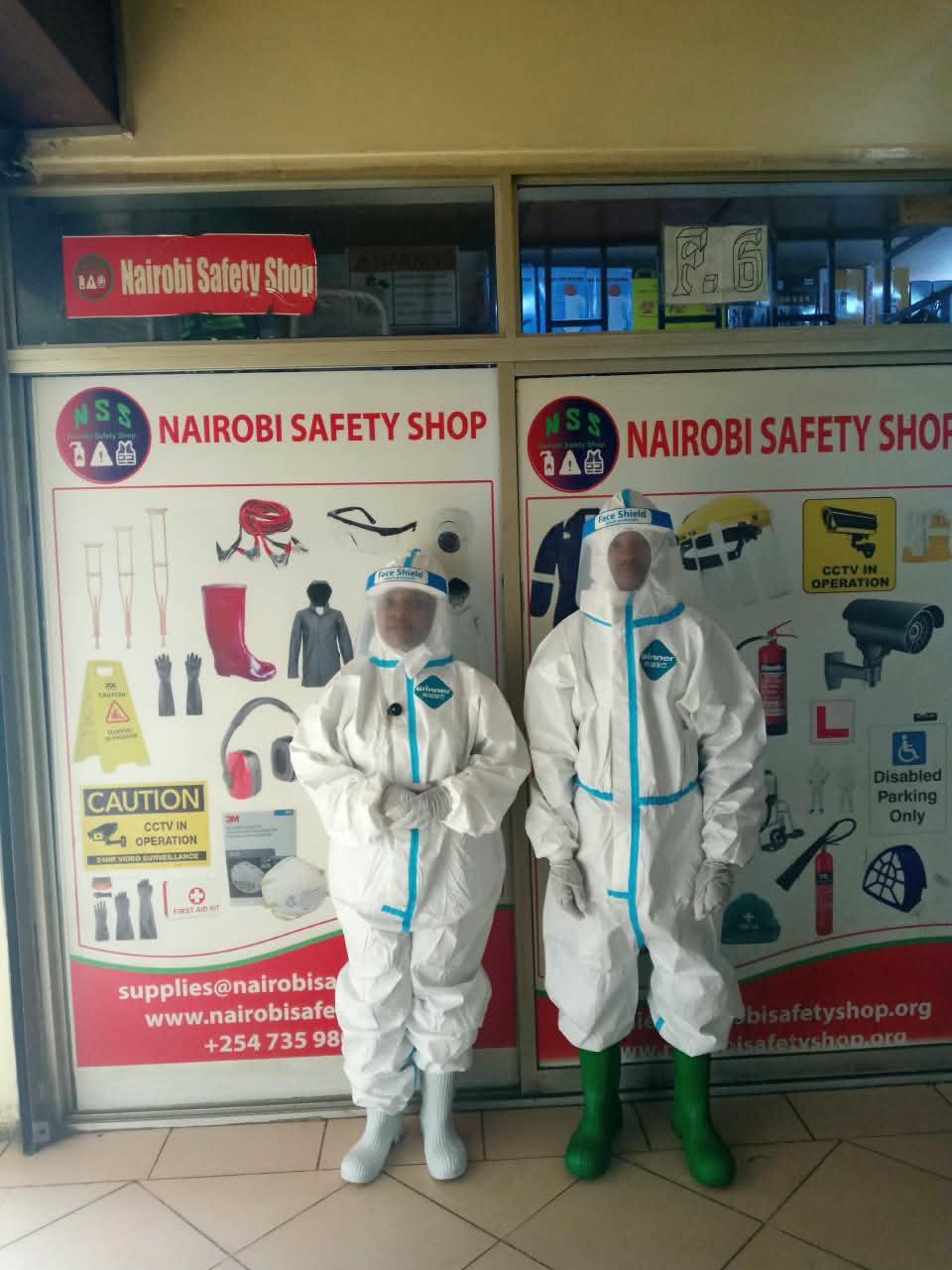
Ebola Protective Coveralls
Protective coveralls can provide full-body coverage as part of an appropriate PPE ensemble.
The coverall shown in Nairobi Safety Shop’s product imagery can therefore be marketed in the context of:
Ebola preparedness
Viral hemorrhagic fever preparedness
Healthcare infection control
Emergency PPE stockpiling
Cleaning and decontamination operations
Healthcare waste-management preparedness
However, do not automatically describe an ordinary disposable coverall as “Ebola-certified” or “Ebola-proof.”
The actual level of protection depends on the garment’s documented specifications and the required standard for the intended activity.
WHO publishes technical information and PPE specifications for Ebola response, while current CDC guidance specifies particular PPE configurations for specific clinical circumstances.
What PPE May Be Required for Ebola Response?
Depending on the patient condition, task and applicable protocol, an Ebola PPE ensemble may involve:
Protective Coverall or Gown
Provides body coverage.
Gloves
Protect the hands from contamination.
Extended-Cuff Gloves
May be required in certain higher-risk clinical settings.
Goggles or Face Shield
Protect mucous membranes of the eyes and face.
Respiratory Protection
The appropriate respiratory protection depends on the clinical situation and applicable guidance.
Hood / Head Cover
Protects the head and neck where required.
Boots or Boot Covers
Protect footwear and lower legs according to the PPE protocol.
Apron
May be incorporated into some PPE configurations.
For example, current CDC guidance for confirmed Ebola patients or clinically unstable suspected patients includes an impermeable coverall or appropriate gown, apron, two pairs of gloves, eye/face protection, head protection, respiratory protection and boot covers under the specified protocol.
The exact PPE configuration must follow the applicable healthcare protocol rather than being assembled solely from a product list.
PPE Is Only One Part of Ebola Infection Control
One of the most important SEO and educational messages for this page is:
PPE alone does not prevent Ebola transmission.
Effective Ebola infection prevention requires a coordinated system.
The system includes:
Early identification
↓
Isolation
↓
Hand hygiene
↓
Appropriate PPE
↓
Safe patient care
↓
Environmental cleaning
↓
Waste management
↓
Decontamination
↓
Safe doffing
↓
Monitoring and training
↓
Exposure management
This is consistent with WHO’s broader Ebola preparedness and IPC approach.
The Importance of Correct PPE Donning and Doffing
Correctly putting on PPE is called donning.
Correctly removing PPE is called doffing.
Both are critical.
Improper removal of contaminated PPE can expose healthcare workers to infectious material.
WHO provides specific resources covering putting on and removing Ebola PPE, including coverall and gown/head-cover procedures.
CDC also provides detailed current Ebola PPE job aids and training resources for healthcare settings.
Nairobi Safety Shop SEO opportunity
This should become a separate supporting article:
“How to Don and Doff Ebola PPE Safely: Training Guide for Healthcare Workers”
That page can link back to:
Ebola Preparedness in Kenya
and then to relevant PPE product pages.
🧤 Ebola PPE Equipment Checklist
Healthcare and emergency-response organizations can use the following as a planning checklist, subject to their applicable protocols.
Body Protection
☐ Protective coveralls ☐ Protective gowns ☐ Aprons ☐ Head covers ☐ Boot covers
Hand Protection
☐ Disposable gloves ☐ Extended-cuff gloves ☐ Appropriate reusable protective gloves where required
Face & Eye Protection
☐ Goggles ☐ Face shields
Respiratory Protection
☐ Appropriate masks/respirators according to risk assessment and protocol
Supporting Equipment
☐ Hand-hygiene supplies ☐ Disinfectants appropriate for the setting ☐ Waste containers ☐ Biohazard bags ☐ Sharps containers ☐ Cleaning equipment ☐ Isolation-area supplies ☐ First aid supplies ☐ Emergency communication equipment
🏥 Ebola Preparedness for Hospitals in Kenya
Hospitals should have a comprehensive preparedness program rather than simply purchasing PPE.
A hospital Ebola preparedness plan may address:
1. Triage
How will potentially infectious patients be identified?
2. Isolation
Where will suspected patients be safely assessed?
3. PPE
What PPE is available and appropriate for different clinical scenarios?
4. Training
Have healthcare workers practiced donning and doffing?
5. Waste Management
How will potentially infectious waste be handled?
6. Environmental Cleaning
How will potentially contaminated areas be safely cleaned?
7. Laboratory Testing
How will samples be collected, transported and tested according to authorized procedures?
8. Staff Exposure
What happens if a healthcare worker has a possible exposure?
9. Communication
Who informs hospital leadership and public-health authorities?
10. Continuity of Care
How does the hospital continue essential healthcare services during an emergency?
🧪 Ebola Preparedness for Laboratories
Laboratories involved in Ebola diagnosis or specimen handling require specialized procedures, training and infrastructure.
Preparedness can include:
- Appropriate PPE
- Specimen-handling protocols
- Biosafety procedures
- Secure specimen transport
- Laboratory communication
- Emergency procedures
- Staff training
- Exposure-response plans
Kenya’s Ministry of Health has identified laboratory capacity as an important component of national Ebola preparedness.
🚑 Ebola Preparedness for Ambulance & Emergency Teams
Ambulance and emergency teams may encounter suspected infectious patients before diagnosis is confirmed.
Preparedness should therefore address:
- Patient assessment
- PPE availability
- PPE donning/doffing
- Patient movement
- Vehicle cleaning
- Waste handling
- Communication
- Exposure management
- Coordination with receiving facilities
Emergency personnel should use procedures established by their healthcare organization and competent authorities.
🧹 Ebola Cleaning & Environmental Safety
Environmental cleaning is an important component of infection prevention.
WHO identifies infection prevention, PPE and waste-management materials as important components of Ebola control.
Organizations should establish procedures for:
- Cleaning
- Disinfection
- Waste segregation
- Contaminated materials
- Laundry where applicable
- Spill response
- PPE removal
- Environmental monitoring
Cleaning personnel should receive appropriate training and PPE for their assigned tasks.
🗑️ Ebola Waste Management
Waste generated during the care of patients with Ebola can require special handling.
Preparedness plans should address:
- Waste segregation
- Appropriate containers
- Sharps management
- PPE
- Collection
- Temporary storage
- Transport
- Treatment/disposal
- Worker protection
WHO specifically recognizes waste management as an important part of Ebola PPE and infection-control preparedness.
⚰️ Safe & Dignified Burial Preparedness
Safe and dignified burial is an important component of Ebola outbreak control.
WHO includes safe and dignified burials among the interventions required for outbreak control.
Organizations involved in burial response require appropriate training, procedures and PPE according to public-health guidance.
🏨 Ebola Preparedness for Hotels in Kenya
Hotels may encounter international travellers and therefore benefit from having emergency preparedness procedures.
Hotels should have:
- Emergency contacts
- Staff awareness
- Basic infection-prevention procedures
- Cleaning protocols
- PPE appropriate to assigned duties
- Referral/notification procedures
- Communication plans
Hotels should not attempt to diagnose Ebola themselves.
Any suspected case should be managed according to instructions from healthcare and public-health authorities.
✈️ Ebola Preparedness at Airports & Border Points
Airports and border crossings are strategically important to national preparedness because of international travel and cross-border movement.
Kenya’s Ministry of Health has been strengthening surveillance, screening and border-health measures as part of its Ebola preparedness.
Relevant preparedness areas include:
- Screening systems
- Staff PPE
- Isolation arrangements
- Communication
- Emergency transport
- Laboratory coordination
- Border-health procedures
🇰🇪 Ebola Preparedness in Nairobi
Nairobi is particularly important to Kenya’s health-security infrastructure because it contains major hospitals, laboratories, government institutions, international transport connections and healthcare facilities.
The Ministry of Health reported that Kenya’s Ebola response capacity includes designated facilities in Nairobi and elsewhere, with ongoing preparedness and isolation capacity.
Organizations in Nairobi that may benefit from Ebola preparedness planning include:
- Hospitals
- Private clinics
- Laboratories
- Universities
- Research facilities
- Ambulance providers
- Hotels
- Airports
- Cleaning contractors
- Waste-management companies
- Humanitarian organizations
- Government facilities
🗺️ Ebola Preparedness Across Kenya
Preparedness should not be limited to Nairobi.
Kenya’s regional preparedness can be especially important around:
- Busia
- Lwakhakha
- Western Kenya
- Major airports
- Ports
- Border crossings
- High-volume transport corridors
- Major hospitals
- County referral hospitals
The Ministry of Health has highlighted border surveillance and response capacity as part of the national strategy.
🦠 Ebola & Marburg Preparedness
Ebola should also be considered within the broader category of viral hemorrhagic fever preparedness.
WHO’s 2026 infection-prevention guidance specifically addresses Ebola and Marburg diseases, emphasizing preparedness, IPC and multisectoral response.
This creates another important SEO cluster for Nairobi Safety Shop:
Ebola PPE Kenya
→ Marburg PPE Kenya
→ Viral hemorrhagic fever PPE Kenya
→ Infection prevention equipment Kenya
→ Healthcare emergency PPE Kenya
→ Outbreak preparedness equipment Kenya
🌡️ Heat Management When Wearing Ebola PPE
This is an important issue for Kenya and other tropical environments.
Full-body PPE can increase heat burden because it restricts normal cooling through sweating.
Current CDC guidance for international Ebola treatment settings emphasizes heat-related illness prevention, acclimatization, work/rest schedules and opportunities to remove PPE, cool down and rehydrate.
Therefore, Ebola preparedness should include not only PPE procurement but also:
- Staff training
- Work/rest planning
- Hydration
- Appropriate clinical-area design
- Heat monitoring
- Adequate staffing
- PPE-change procedures
🧾 Ebola PPE Procurement Checklist for Kenya
Before purchasing protective equipment, organizations should ask:
Product
- What type of garment is it?
- What material is used?
- Is it disposable or reusable?
- Does it have a hood?
- Does it have elasticated cuffs?
- Does it provide the required body coverage?
Protection
- What protection standard applies?
- Has the product been tested?
- Is documentation available?
- Is it appropriate for fluid exposure?
- Is it suitable for the intended task?
Supply
- What sizes are available?
- What quantities are available?
- What is the lead time?
- Can the supplier provide bulk quantities?
- Is replacement stock available?
Training
- Are staff trained?
- Are donning/doffing procedures established?
- Are emergency drills conducted?
⚠️ Don’t Buy PPE Based Only on the Word “Ebola”
This is one of the most important purchasing messages.
A product description saying:
“Ebola suit”
does not automatically establish that the garment provides the required protection.
Buyers should request appropriate:
- Manufacturer specifications
- Test reports
- Applicable certifications
- Product standards
- Fluid-resistance information
- Instructions for use
- Sizing information
WHO has published technical guidance and specifications for PPE used in Ebola response.
🚫 Avoid These Dangerous Marketing Claims
Nairobi Safety Shop should not describe a product as:
❌ “100% Ebola-proof”
❌ “Guaranteed Ebola protection”
❌ “Ebola-certified” without certification
❌ “Kills Ebola”
❌ “Prevents Ebola”
❌ “Complete protection against Ebola”
unless the exact claim is supported by appropriate evidence and applies to the product and intended use.
Instead use:
✅ Ebola preparedness PPE
✅ Protective coverall for infection-control applications
✅ PPE for viral hemorrhagic fever preparedness
✅ Protective clothing for healthcare and emergency-response applications
✅ PPE suitable for specified fluid-exposure applications, according to manufacturer documentation
🛒 Nairobi Safety Shop: Ebola Preparedness & PPE Supplier in Kenya
Organizations searching for Ebola PPE in Kenya, protective coveralls in Nairobi, infection-control equipment, healthcare PPE and emergency preparedness supplies can consider Nairobi Safety Shop as a source for relevant safety equipment.
The Nairobi Safety Shop official website provides safety, health and security equipment and information for organizations in Kenya.
Relevant product categories for Ebola preparedness can include:
Protective Clothing
- Disposable coveralls
- Protective coveralls
- Protective gowns
- Aprons
- Other protective clothing
Hand Protection
- Disposable gloves
- Protective gloves
- Extended-cuff gloves where applicable
Eye & Face Protection
- Safety goggles
- Face shields
Foot Protection
- Protective boots
- Gumboots
- Boot covers where applicable
Emergency & Healthcare Supplies
- First aid kits
- Emergency supplies
- Safety signs
- Waste-management products
Product suitability must always be verified against the organization’s specific infection-control requirements and applicable standards.
🏥 Ebola Preparedness Checklist for Kenyan Healthcare Facilities
Infection Prevention
☐ Hand-hygiene program ☐ Appropriate PPE ☐ Isolation procedures ☐ Environmental cleaning procedures ☐ Waste-management procedures ☐ Safe patient movement procedures
Staff
☐ Ebola awareness training ☐ PPE donning training ☐ PPE doffing training ☐ Exposure-response training ☐ Heat-stress awareness
Equipment
☐ Coveralls/gowns ☐ Gloves ☐ Goggles ☐ Face shields ☐ Appropriate respiratory protection ☐ Head protection ☐ Boots/boot covers ☐ Aprons ☐ Waste containers ☐ Disinfection supplies
Emergency Management
☐ Emergency contacts ☐ Referral arrangements ☐ Isolation capacity ☐ Laboratory coordination ☐ Communication plan ☐ Stock monitoring ☐ PPE replenishment plan ☐ Emergency drills
🏢 Ebola Preparedness for Kenyan Businesses
Most businesses will not directly manage Ebola patients.
Nevertheless, businesses can establish sensible preparedness arrangements.
Businesses should consider:
1. Employee awareness
Know how to respond to health concerns.
2. Emergency contacts
Maintain current healthcare and public-health contacts.
3. Cleaning
Ensure cleaning personnel understand appropriate infection-control procedures.
4. PPE
Maintain PPE appropriate for the organization’s actual activities.
5. Communication
Prevent rumours and misinformation.
6. Business continuity
Prepare for possible staff absenteeism or disruption to operations.
🏫 Ebola Preparedness for Schools & Universities
Educational institutions can incorporate infectious-disease preparedness into broader emergency planning.
Plans may include:
- Health screening procedures where directed by authorities
- Staff awareness
- Cleaning procedures
- Hand hygiene
- Emergency communication
- Referral procedures
- PPE for designated personnel
- Business continuity
- Coordination with health authorities
Schools should avoid creating unnecessary fear or stigma.
🧪 Ebola Preparedness for Laboratories & Research Institutions
Research institutions should have specialized biosafety procedures appropriate to their activities.
Preparedness can include:
- Appropriate PPE
- Laboratory biosafety procedures
- Specimen handling
- Waste management
- Staff training
- Exposure procedures
- Emergency communication
- Equipment inventories
🚑 Ebola Preparedness for Emergency Responders
Emergency responders should be trained for the role they perform.
Potential equipment categories include:
- PPE
- Gloves
- Face protection
- Protective clothing
- Boots
- Emergency communication
- First aid
- Waste-management supplies
The PPE ensemble should be based on the responder’s actual exposure risk and applicable response protocols.
🧠 Ebola Preparedness Is About Systems, Not Just Products
A major mistake organizations make is thinking:
“We bought Ebola PPE, so we are prepared.”
Real preparedness is:
People
Trained personnel.
Processes
Clear SOPs.
PPE
Correct equipment.
Place
Appropriate isolation and work areas.
Procedures
Safe donning, doffing, cleaning and waste handling.
Planning
Emergency communication and coordination.
Practice
Drills and exercises.
Procurement
Reliable replenishment.
🚨 What Should an Ebola Emergency Plan Contain?
A robust plan should identify:
Who?
Who identifies a suspected case?
Where?
Where is the person assessed and isolated?
What?
What PPE is required?
How?
How will the patient be safely moved?
Who communicates?
Who contacts management and public-health authorities?
What happens to waste?
How is potentially infectious waste managed?
What happens to exposed workers?
What is the exposure-management process?
What happens afterward?
How is the incident reviewed and lessons incorporated?
📦 Ebola PPE Stockpiling in Kenya
Healthcare facilities should consider maintaining an appropriate minimum stock level based on:
- Facility size
- Patient volume
- Staffing
- Risk assessment
- Expected emergency duration
- PPE consumption
- Supply-chain reliability
- Storage capacity
Stock should be:
Counted → Stored correctly → Inspected → Rotated → Replenished → Documented
Emergency stockpiling is particularly valuable because an outbreak can rapidly increase demand for PPE.
Ebola Kenya
Ebola preparedness Kenya
Ebola PPE Kenya
Ebola PPE supplier Kenya
Ebola protective clothing Kenya
Ebola coverall Kenya
Ebola PPE Nairobi
Ebola preparedness Nairobi
Ebola infection control Kenya
Ebola emergency supplies Kenya
Ebola response equipment Kenya
Ebola safety equipment Kenya
- Ebola protective suit Kenya
- Ebola protective coverall Nairobi
- disposable Ebola coverall Kenya
- Ebola PPE supplier Nairobi
- healthcare PPE Kenya
- infection prevention PPE Kenya
- viral hemorrhagic fever PPE Kenya
- Marburg PPE Kenya
- Marburg protective equipment Nairobi
- Ebola infection control equipment
- Ebola hospital PPE Kenya
- Ebola emergency preparedness Kenya
- Ebola outbreak preparedness Kenya
- healthcare emergency supplies Nairobi
- infectious disease PPE Kenya
- medical protective clothing Nairobi
- PPE for viral hemorrhagic fever
- Ebola response supplies Kenya
- Ebola preparedness equipment Nairobi
- where to buy Ebola PPE in Kenya
- where to buy Ebola protective coveralls in Nairobi
- Ebola PPE supplier in Nairobi
- Ebola preparedness equipment supplier Kenya
- Ebola protective clothing supplier Kenya
- Ebola coverall supplier Nairobi
- Ebola emergency supplies supplier Kenya
- viral hemorrhagic fever PPE supplier Kenya
- Marburg PPE supplier Nairobi
- infection control PPE supplier Kenya
- hospital PPE supplier Nairobi
- healthcare PPE supplier Kenya
- disposable protective coverall Kenya
- Ebola PPE for hospitals Kenya
- Ebola preparedness supplies for hospitals
- Ebola infection prevention equipment Kenya
Ebola
↓
Ebola Preparedness
↓
Ebola PPE
↓
Infection Prevention & Control
↓
Protective Coveralls
↓
Gloves
↓
Goggles / Face Shields
↓
Respiratory Protection
↓
Boots
↓
Waste Management
↓
Cleaning & Disinfection
↓
Healthcare Training
↓
Emergency Response
↓
Nairobi Safety Shop
We hope we have answered the following:-
1.
Ebola PPE Guide for Healthcare Workers in Kenya
2.
How to Choose Protective Coveralls for Ebola & Viral Hemorrhagic Fever Preparedness
3.
Ebola PPE Donning & Doffing: Healthcare Worker Training Guide
4.
Ebola Infection Prevention & Control Checklist for Kenyan Hospitals
5.
Ebola Emergency Preparedness Checklist for Healthcare Facilities
6.
Ebola Waste Management & PPE Requirements
7.
Ebola & Marburg Preparedness in Kenya
8.
Viral Hemorrhagic Fever PPE Guide for Kenya
9.
Ebola Preparedness for Laboratories in Kenya
10.
Ebola Preparedness for Airports & Border Points in Kenya
11.
Ebola Preparedness for Hotels & Businesses in Kenya
12.
Ebola PPE Procurement Guide for Kenyan Hospitals
13.
How Much PPE Should a Healthcare Facility Stock for an Ebola Emergency?
14.
Disposable Protective Coveralls in Kenya: Uses, Standards & Selection Guide
Ebola Preparedness
→ Protective Coveralls
→ Disposable Coveralls
→ Protective Gloves
→ Safety Goggles
→ Face Shields
→ Protective Boots
→ Gumboots
→ First Aid Kits
→ Safety Signs
→ Waste-Management Equipment
→ Disinfecting/Cleaning Equipment
→ Healthcare PPE
This establishes the relationship:
Nairobi Safety Shop → Ebola → Kenya → PPE → Infection Control → Emergency Preparedness
FAQ SEO Section
Where can I buy Ebola PPE in Kenya?
Nairobi Safety Shop supplies a range of PPE and safety equipment in Kenya. Organizations should verify the specifications and certification of each product against their intended Ebola-response application and applicable infection-control requirements.
Where can I buy Ebola protective coveralls in Nairobi?
Nairobi Safety Shop is a Nairobi-based safety-equipment supplier offering protective clothing and PPE. Buyers should confirm product availability, sizes, specifications and applicable standards before ordering.
What PPE is used for Ebola?
Depending on the situation and applicable protocol, Ebola PPE may include protective coveralls or gowns, gloves, eye/face protection, appropriate respiratory protection, head protection and protective footwear. WHO and CDC guidance should be consulted for the specific clinical scenario.
Is a disposable coverall automatically Ebola-proof?
No. A disposable coverall should not automatically be described as Ebola-proof or Ebola-certified. Its suitability depends on its documented protective characteristics, applicable standards and the intended exposure.
Is Kenya currently experiencing an Ebola outbreak?
As of 7 October 2026, Kenya’s Ministry of Health stated that Kenya does not have an Ebola outbreak, while reporting an imported confirmed case and enhanced preparedness and response measures. Current status can change, so follow official Ministry of Health and WHO updates.
Does PPE alone prevent Ebola?
No. PPE is one component of infection prevention and control. Effective Ebola response also requires surveillance, isolation, hand hygiene, safe patient care, environmental cleaning, waste management, training, laboratory services and other measures.
Is Ebola the same as Marburg?
No. Ebola and Marburg are different viral diseases, although both are viral hemorrhagic fevers and require strong infection-prevention and preparedness measures. WHO’s 2026 IPC guidance addresses both diseases.
Ebola Kenya · Ebola Preparedness Kenya · Ebola PPE · Ebola PPE Kenya · Ebola Nairobi · Infection Control Kenya · Viral Hemorrhagic Fever · Marburg Kenya · Healthcare PPE Kenya · Emergency Preparedness Kenya · Ebola Protective Clothing · Ebola Coverall · PPE Supplier Nairobi · Safety Equipment Kenya · Nairobi Safety Shop
Recommended authoritative sources
World Health Organization — Ebola disease WHO Ebola Disease Information
WHO — Personal Protective Equipment for Ebola WHO Ebola PPE Guidance
WHO — 2026 Ebola & Marburg IPC Guidance WHO Ebola & Marburg IPC Guideline
Kenya Ministry of Health — Ebola preparedness Kenya Ministry of Health Ebola Preparedness Updates
CDC — Ebola clinical guidance CDC Ebola Clinical Guidance
Health and safety information disclaimer: This article is intended for general Ebola preparedness and occupational-safety information. It is not a substitute for clinical guidance, diagnosis, treatment, infection-prevention protocols or instructions from Kenya’s Ministry of Health, WHO, qualified healthcare professionals or other competent authorities. PPE must be selected and used according to the specific task, exposure risk, manufacturer’s instructions and applicable standards.